The More Compartments, the More Order? A Drawer Organiser Myth
Drawer organiser choices shape how easily a space adapts. Compare fixed dividers, adjustable trays and open storage to choose a layout that stays useful.
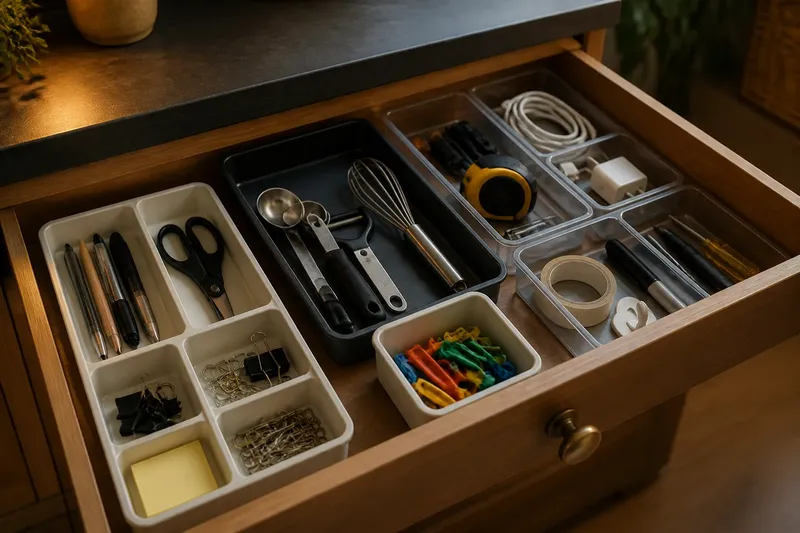
The common mistake with a drawer organiser is buying the one with the most compartments and expecting order to follow. Drawer organiser choices can instead cost you usable space and make ordinary items awkward to put away when a drawer’s contents change.
A divider is useful when it gives a recurring group of objects a clear place. But drawers often collect things with different shapes and routines: pens beside envelopes, cooking tools beside clips, or spare cables that appear and disappear. The right setup depends less on compartment count than on how much the contents vary.
Drawer organiser choices depend on how the drawer changes
Before comparing products, notice what the drawer is asked to hold. A cutlery drawer has a fairly steady cast of objects, while a household catchall may shift as seasons, projects, and errands come and go. A layout that works beautifully for one stable collection can frustrate a mixed-use drawer.
Look for the objects that are used together, not simply the objects that look alike. Scissors, tape, and a marker might belong together because they support the same task. A row of tiny pockets for unrelated odds and ends may appear tidy while making each item harder to find.
There are three useful approaches: fixed compartments, adjustable dividers, and open or minimally divided storage. None is universally best. The choice comes down to whether the contents stay consistent, change occasionally, or are too varied for rigid slots.
Fixed compartments suit steady collections
Fixed trays with built-in sections are a good fit when the drawer holds a predictable set of objects in repeatable quantities. A cutlery tray, for instance, separates forks from serving spoons without asking anyone to redesign the space each time. A desk tray with a few distinct wells can also work well for a stable collection of pens, clips, and sticky notes.
The drawback is that each section has a predetermined shape. A long utensil may not fit a narrow slot; a larger tool can take over a small compartment; and empty pockets cannot always be combined to make room. Before buying, compare the tray’s internal sections with the actual objects, rather than judging only by its outside dimensions or polished appearance.
Fixed sections suit people who value quick, consistent placement and whose drawer contents rarely shift. They are less suitable for a drawer that has to serve as a changing landing place for household odds and ends.
Adjustable dividers leave room for change
Adjustable dividers, including removable plastic inserts or spring-loaded drawer dividers, let you alter the boundaries between groups. They are useful when the general categories are stable but the objects within them vary. A kitchen drawer might need room for a wide spatula one day and a cluster of smaller tools in another section.
This flexibility has limits. Some dividers slide out of position, while others occupy more room than their thin profile suggests. A collection of adjustable pieces can also become a small project of its own if every change prompts another round of rearranging. Choose a simple arrangement that can adapt without requiring constant attention.
Adjustable dividers suit people who want separation but expect occasional change. They can be a sensible middle ground for a shared drawer, where different people use the same space and need broad, visible zones rather than a precise slot for every object.
Open storage works for mixed and shifting contents
Open trays, a single broad bin, or no organiser at all can be more useful when the contents are irregular. A large compartment lets a tape measure sit beside a packet of batteries without forcing either object into a too-small pocket. Shallow trays can still keep categories apart while preserving room for an oddly shaped item.
Open storage does not mean tossing everything together. Give groups broad boundaries: writing supplies in one tray, repair odds and ends in another. If a drawer becomes difficult to scan, add one divider or a removable dish where it solves a specific problem. Resist filling every spare corner just because a product offers another compartment.
This approach suits a multipurpose drawer, a household with changing projects, or anyone who prefers to move items around as needs arise. It may be less satisfying for small objects that need firm separation to stay visible.
Choose the arrangement that fits your habits
Say you use a kitchen drawer for measuring spoons, a peeler, bag clips, and a few miscellaneous tools. If you buy a fixed tray with a narrow pocket for each item, the peeler’s handle might crowd its slot while clips spread across unused sections. An open tray for the larger tools and a small removable cup for clips could leave the drawer easier to use; the observable difference is that items can be put away without forcing them into mismatched spaces.
To make the choice, take the current contents out and group them by task. Set aside anything that does not belong in the drawer, then note which groups stay stable and which often change. Use that distinction to decide how much structure to buy:
- Choose fixed compartments for a consistent collection with objects that fit the sections comfortably.
- Choose adjustable dividers when you want clear zones but expect the group sizes or object shapes to shift.
- Choose open trays or broad bins when the drawer serves several purposes or holds irregular objects.
- Leave some space unassigned so a new item can fit without forcing a full rearrangement.
- Check the drawer’s usable interior and the organiser’s outside edges, including any handles or rails that narrow the opening.
For a shared drawer, agree on broad zones rather than exact positions. A household member can remember “tape and scissors in this tray” more easily than a map of many tiny compartments. If the drawer is personal and its contents stay the same, more precise divisions may feel natural instead.
What should you ask before buying a drawer organiser?
How many compartments should a drawer organiser have?
There is no useful target number by itself. Choose enough sections to separate recurring groups, while leaving room for objects that do not fit a standard shape.
Are adjustable drawer dividers better than fixed trays?
Adjustable dividers are more adaptable, while fixed trays can provide dependable places for stable collections. Pick the one that suits how often the contents change, not the one with the longer feature list.
Can a drawer stay organized without an organiser?
Yes, if a few broad groups are easy to see and return to their places. A tray or divider is worth adding only when it addresses a recurring tangle or makes a useful category easier to find.
What should I check before ordering a tray?
Check the usable interior, the drawer opening, and whether the largest objects fit the proposed sections. Product dimensions and drawer hardware vary, so rely on the product label or manufacturer’s instructions for fit details.
Let the drawer keep some flexibility
A drawer organiser should support the way you already use a space, not turn every object into a resident of a tiny assigned room. For steady collections, fixed compartments can make returning things simple. For changing collections, adjustable or open storage often leaves more room to adapt.
When comparing drawer organiser choices, imagine putting away the most awkward item in the drawer, not just the smallest one. If it has an obvious place and there is still room for the collection to change, the organiser is doing useful work. If every section must be filled to make the purchase seem worthwhile, fewer dividers may be the better buy.